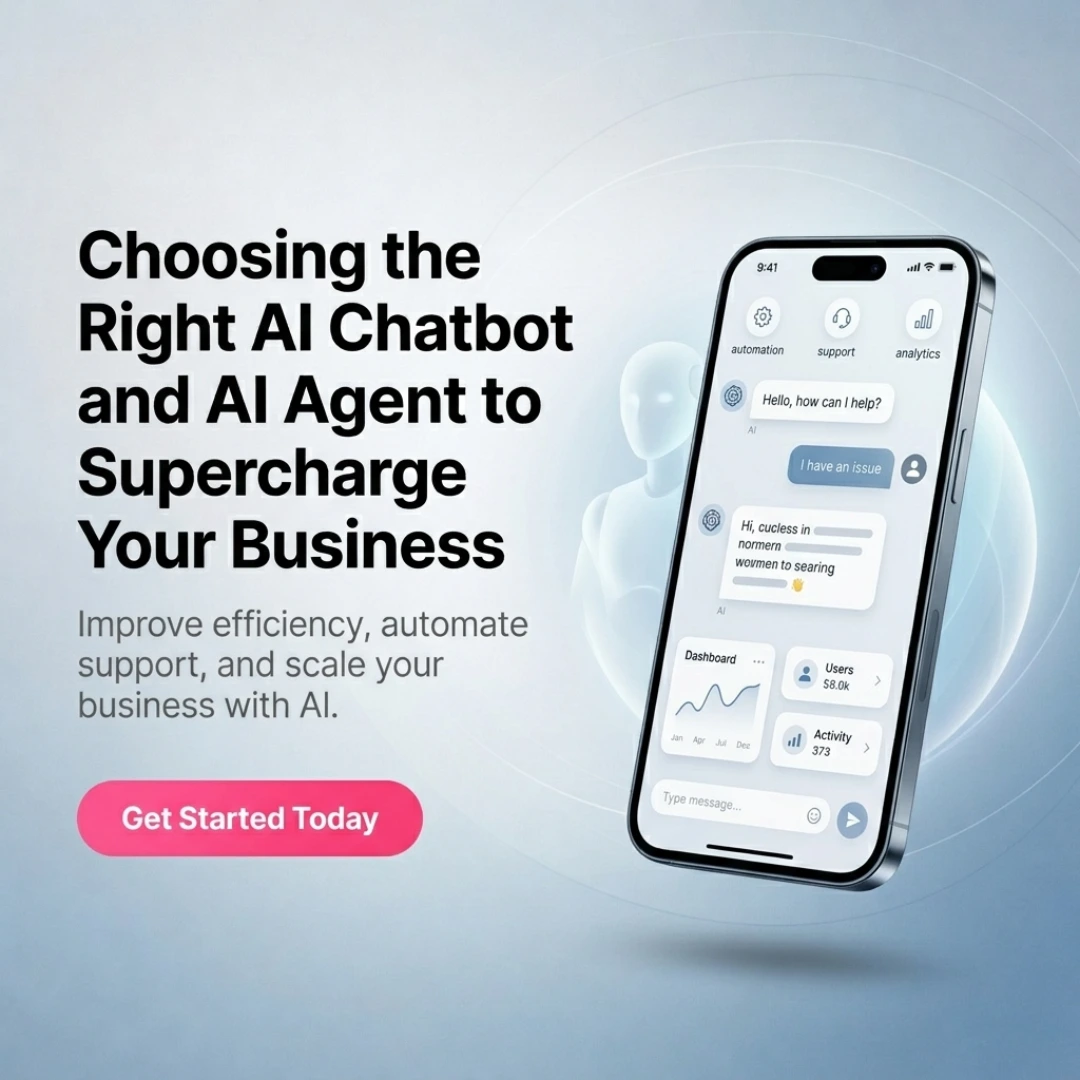
Choosing the Right AI Chatbot and AI Agent to Supercharge Your Business
Running a small business these days is akin to juggling chainsaws while riding a unicycle. You’re stretched thin, clients want rapid responses, and you’re competing for every scrap of market share.
You’ve certainly heard a lot about AI chatbots and agents, and how they operate like magic in businesses. But, are they? Which one genuinely helps you prevent a complete meltdown?
Because, let’s face it, you don’t have time for another failed tech experiment.
We’re cutting through the hoopla and informing you exactly what these items accomplish, so you can decide which one (or both) will save your sanity and increase your bottom line.
What is an AI Chatbot?

An AI chatbot is a computer software that simulates human speech. Consider it a digital conversation partner designed to engage with clients via text or voice interfaces.
Chatbots, which employ natural language processing (NLP), can interpret and answer to user queries, giving quick service and information such as “What are your opening hours?” or “How do I track my package?”
However, it is not a mind reader; it can only answer questions it has been taught and cannot handle difficult problems.
Key Benefits for SMEs
According to a Salesforce survey, 81% of customers want faster service as technology develops, and 73% demand better personalization, highlighting the need of SMEs using applicable AI solutions to maximize efficiency.
Implementing chatbot technology is a strong option that provides a variety of benefits aimed at streamlining operations, increasing customer interaction, and driving growth.
Let’s take a look at the primary benefits they bring to your business.
- Customers in different time zones can receive 24-hour online customer help, even when actual staff is unavailable.
- Lead generation and customer qualification are accelerated through interactive dialogues that gather critical contact information and precisely estimate lead potential.
- Automated FAQs and basic inquiries enable SMEs to significantly improve operational efficiency and customer happiness by rapidly handling typical issues, freeing up workers to focus on high-value tasks.
Practical Use Cases
Businesses in practically every area are finding practical, tangible uses for AI Chatbots, from e-commerce to appointment juggling in service industries.
Here’s how they are deployed:
- E-commerce chatbots can readily answer questions like “Where is my order?” and “What are your product recommendations?” Tidio revealed that online retailers that implemented chatbots experienced a median 20% increase in order value within the first week, suggesting a rapid and significant sales impact.
In Malaysia, chatbots like as Cleo from Lazada help users with their online shopping experience by answering product-related questions and assisting with the online purchasing process.
Platforms like as Rakan Sales CRM Malaysia combine chatbot capabilities with sales CRM features to unify WhatsApp, Facebook, and email discussions into a single dashboard for firms managing client connections outside of e-commerce.
- Service-based businesses
Chatbots are also ideal for booking appointments and providing initial support.
For service-based businesses like Yellow Class, an online education platform swamped with new customer inquiries, chatbots provide a solution to the pain points of high inquiry volume and delayed responses, assisting over 35,000 consumers.
When AI Chatbot Alone is Not Enough
Chatbots are excellent at managing simple, repetitive jobs, but their limitations emerge when dealing with complicated, nuanced consumer interactions.
They frequently fail to maintain contextual awareness over lengthy talks, misread equivocal language or emotional cues, and lack the complex problem-solving abilities of human agents.
If your company deals with complex client concerns or requires advanced problem solving, a chatbot may fall short because it relies primarily on pre-programmed responses and cannot adapt to new conditions.
As a result, depending only on chatbots may lead to customer frustration and a poor customer experience. A more efficient way is to use a hybrid model that strategically combines AI efficiency with human agents’ sensitivity and adaptability.
This enables businesses to automate easy operations while ensuring that difficult and sensitive issues receive the tailored attention they demand, resulting in increased efficiency and customer satisfaction.
What is an AI Agent?
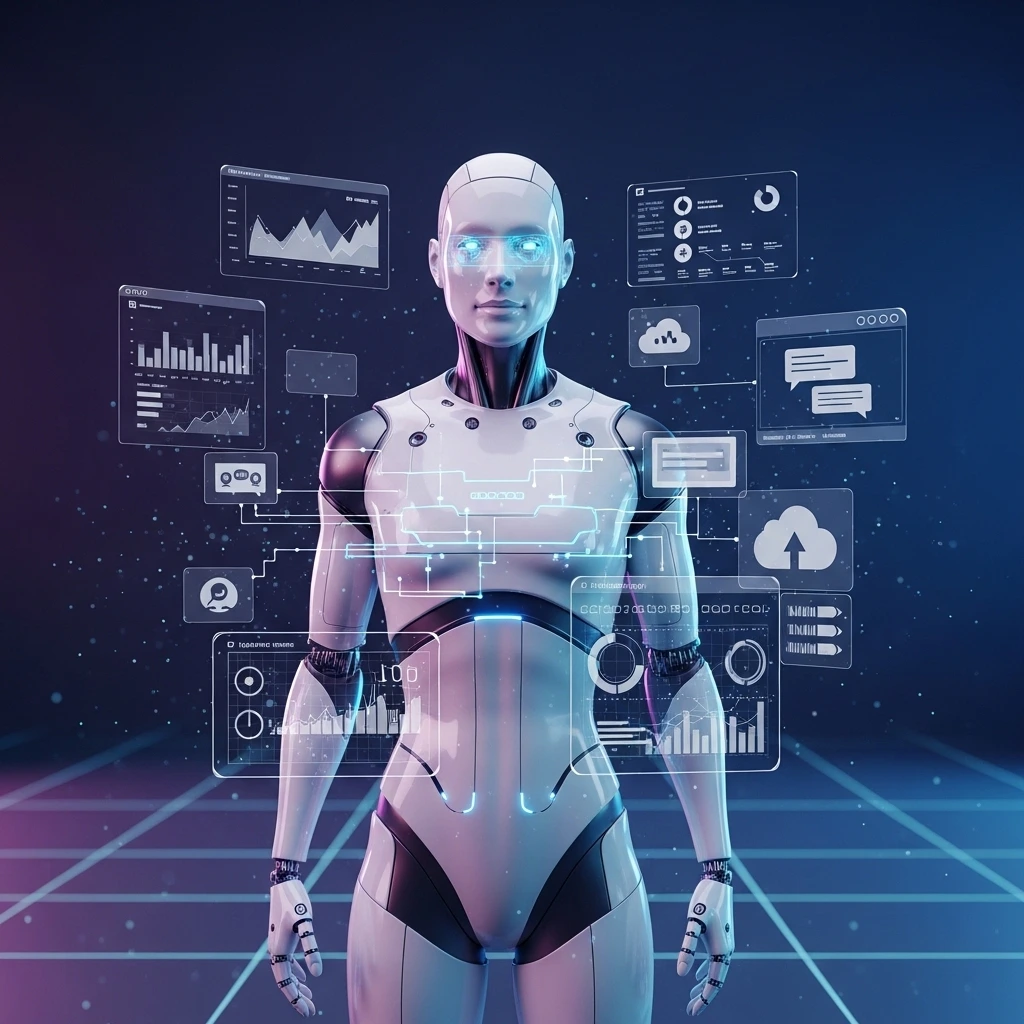
AI agents are advanced artificial intelligence systems that advance automation to the next level. Unlike chatbots, they can understand context and solve complicated, open-ended problems with minimum human intervention.
Consider them a highly skilled digital employee capable of proactively solving problems and optimizing procedures.
They accomplish this using modern technologies such as Large Language Models (LLMs) and reinforcement learning, which allow them to process and comprehend massive volumes of data from many sources.
These agents excel at tolerating uncertainty, making autonomous judgments, and orchestrating complex plans, exhibiting cognitive capabilities much above those of simpler automated systems.
Advanced Capabilities that Benefit Business
For SMEs looking to alter their business processes, AI agents present a tremendous potential to streamline workflows, revolutionize customer interactions, and unleash the power of data-driven insights.
Here’s how AI agents are helping SMEs improve efficiency and growth:
- AI agents help SMEs move from reactive to proactive problem-solving by detecting possible bottlenecks and initiating automated solutions. These agents examine data to predict difficulties like as stock outs or client turnover, allowing for proactive measures. For example, an agent may proactively replenish low-stock items based on anticipated demand, avoiding stockouts and lowering storage expenses.
- They can also provide a sense of personalised attention by adapting to your customer’s communication style and responses based on customer profiles using deep machine learning. This behavior allows them to provide tailored advice, focused marketing campaigns, and proactive customer support while also adjusting to the company’s own staff, learning their working patterns and delivering personalized assistance.
- Strategic choices are frequently hampered by SMEs’ limited data analysis capabilities, but AI agents can help by offering rapid analysis of sales, customer, and market data, resulting in practical insights for better operations. This results to streamlined pricing, targeted marketing, and the identification of new growth opportunities, all displayed in clear visuals.
- AI agents interface effortlessly with a variety of tools, including the Best CRM software in Malaysia and ERP, automating processes across several platforms. This provides improved processes by automating data entry, report generation, and process execution, saving substantial time and resources. An agent, for example, may automatically extract data from CRM software and import it into accounting software, or activate marketing campaigns based on e-commerce platform sales data.
Practical Use Cases
Indeed, corporations are rapidly increasing their use of AI bots to undertake more complex jobs. These tendencies are especially noticeable in industries such as:
- E-commerce
Perplexity AI has set a precedent by forming a strategic alliance with Stripe that adds an important layer of security, promoting consumer confidence in AI-powered buying for customers. - Marketing
Leading software companies, including Microsoft, are introducing AI agents designed to significantly automate key business functions, allowing businesses to streamline recruitment, sales lead generation, content creation, and IT management, thereby freeing up valuable resources for strategic projects.
Overcoming Implementation Challenges
Implementing AI agents is not a plug-and-play scenario, so let’s take a deeper look at the obstacles and solutions:
- Data requirements
To begin, solid data is essential for any successful AI deployment. SMEs should start with a thorough data audit, identifying existing resources and gaps.
This method guides the development of a targeted data gathering strategy, which is reinforced by thorough cleaning and preprocessing to assure accuracy. - Integration Complexities
When data is scarce, experimenting with augmentation techniques or utilizing additional datasets can be extremely beneficial. Integration issues are another key impediment.
Prioritizing AI solutions with robust APIs and deploying middleware or cloud-based platforms can help to speed the process. A staged rollout, beginning with simpler integrations, enables for progressive uptake while minimizing disturbance. - Budget Concerns
Budget restrictions, which are frequently a main concern for SMEs, can be overcome by using cloud-based AI solutions with pay-as-you-go models, leveraging open-source tools, and collaborating with experienced vendors who understand SME requirements.
Focusing on high-ROI use cases and running proof-of-concept trials improves cost-effectiveness. - Data Privacy and Security
Beyond technical considerations, ethical implications necessitate close attention. Data privacy and security must be prioritized, with SMEs following relevant rules and establishing strong measures.
This involves getting express consent, encrypting data, and doing regular security audits. - Building Customer Trust Through Transparency
Transparency is essential for gaining customer trust; SMEs should explicitly define how AI is utilized, offer opt-out alternatives, and explain AI-driven judgments. Establishing accountability through designated oversight and audit trails promotes appropriate AI deployment.
Businesses that proactively address these implementation and ethical concerns can effectively integrate AI agents, driving innovation while maintaining customer trust and ethical integrity.
Choosing the Right AI Solution for Your Business
In just four years, by 2028, Gartner predicts that autonomous AI agents would manage 15% of regular business decisions, a sharp difference to the current situation.
To benefit on this disruptive technology, businesses must first assess their needs and then invest in AI solutions that are not only beneficial but also adapted to their specific business context.
Understanding the distinctions between AI chatbots and AI agents is critical to strategic decision-making. Businesses must determine which tool best matches with their operational means, as they offer various functionalities:
| Feature | AI Chatbot | AI Agent |
| Primary Function | Conversational interaction, information retrieval, and simple task execution. | Autonomous task execution, complicated decision-making, and proactive issue solving. |
| Complexity | Relatively simple, frequently based on rules or prepared scripts. | Highly complicated, it employs advanced AI (such as massive language models) to comprehend context, learn, and adapt. |
| Autonomy | Limited; follows predetermined paths and requires human intervention for difficult problems. | High; capable of independently planning and executing tasks, learning from experiences, and making real-time decisions. |
| Contextual Understanding | Basic; understands keywords and simple phrases, but may struggle with complex inquiries. | Advanced; recognizes context and intent, and is capable of handling complicated, multi-step interactions. |
| Use Cases | Customer support, FAQs, basic information dissemination, and simple workflow automation. | Complex workflow automation, data analysis, intelligent process optimization, and proactive problem solving. |
| Learning Capabilities | Limited learning, primarily reliant on updating pre-existing training data. | Capable of powerful machine learning, dynamic learning, based on interactions, and data processing. |
Consider AI in an office setting, where the AI chatbot acts as a receptionist, taking calls, directing visitors, and providing basic information. They’re great at handling routine chores and adhering to established routines.
An AI agent, on the other hand, functions more like a highly trained executive assistant, performing activities beyond their scope, managing complex schedules, anticipating needs, and making autonomous judgments. Their role is to proactively address issues and optimize procedures, essentially serving as a strategic partner rather than a task executor.
The decision between AI chatbots and agents is based on your company’s specific demands.
- Chatbots are a suitable and cost-effective alternative for businesses looking to automate routine customer service or give consistent, timely information.
- However, whether it comes to automating complex operations, optimizing decision-making, or extracting deep insights from data, AI agents are crucial.
Hybrid Approaches: The Best of Both Worlds
Recognizing that many firms operate at varying levels of complexity, hybrid techniques provide the best of both worlds.
The use of chatbots for initial encounters, such as answering FAQs or gathering basic data, and seamlessly escalating difficult issues to AI agents for advanced problem-solving, will give the optimal efficiency for a company’s function.
Importantly, this method works equally well for internal operations, where chatbots can automate data entry, and AI agents can handle complex data analysis, maximizing total operational performance.
Essential Tools & Resources for Your Business
Demystifying AI deployment begins with readily available resources.
Here’s a list of the various platforms and research hubs that can help your organization traverse the world of artificial intelligence:
- User-friendly Platforms
- Microsoft Azure
Microsoft Azure provides a wide range of AI services to enterprises, including natural language processing, machine learning, computer vision, and cognitive search. They offer customized models, allowing organizations to create and train AI models to match their individual requirements.
Their Azure Bot Service also helps with the development and deployment of intelligent bots.
Azure, which has been adopted by 95% of Fortune 500 firms, provides a dependable and scalable AI foundation for your business. - IBM Watson Assistant
A common strategy utilized for implementing Watson Assistant (Source: IBM). This platform includes tools for designing complex dialog flows and managing multi-turn discussions. They also provide useful tools for analyzing consumer interactions and identifying areas for development. - Amazon SageMaker
Amazon SageMaker enables businesses to seamlessly integrate machine learning into core processes, resulting in considerable gains across a variety of sectors.
Retailers, for example, can use SageMaker to personalize consumer experiences using predictive analytics, whereas manufacturers can use predictive maintenance models to optimize manufacturing processes and save downtime and costs.
- AI Research Papers
Staying up to date on the latest AI research can help firms uncover new opportunities and create unique solutions.
AI’s rapid progress generates a steady stream of unique techniques, algorithms, and applications that can be used to change processes and open up new market opportunities.
Platforms such as arXiv, Google AI Research, and Microsoft Research enable easy access to cutting-edge research publications, allowing you to identify emerging patterns and breakthroughs.
Transform Your SME with AI Today!
Malaysia is at the forefront of AI innovation thanks to rapid technology breakthroughs and a digitally proficient population.
This rise in adoption by both businesses and the government heralds a revolutionary era in which AI will reinvent consumer engagement and accelerate digital evolution across the nation.
Why leave potential untapped?
If your SME wants to use AI but is struggling to find funding, we can help!
Revenue Discovery, an experienced AI chatbot developer and software firm, has been trusted by multinational corporations such as Intel as well as government-linked organizations such as MCMC, MBPP, and others.
Revenue Discovery also provides funding solutions for SMEs, such as the NCER Grant, which can be especially advantageous for software development companies.
If you want to enhance your AI capabilities, such as creating advanced chatbots and AI agents, these grants can be quite beneficial to your company.
With these 18 Latest SME Grants for Malaysian Businesses (2026), you can seize the opportunity to advance your firm forward with AI-driven solutions!
Frequently Asked Questions
1. Are AI chatbots restricted to website interactions?
No, that is a prevalent myth. While websites are common deployment platforms, AI chatbots are extremely adaptable. They can be built into chat apps, social media sites, mobile applications, and even products themselves.
This enables firms to approach clients through several channels, ensuring consistent support and engagement.
2. Will AI chatbots completely replace human customer care agents?
That is a misconception. AI chatbots are intended to complement, not replace, human agents. They serve as “co-pilots,” managing everyday activities and initial inquiries (L1 and L2).
This frees up human agents to concentrate on complicated challenges that necessitate critical thinking, problem-solving, and emotional intelligence.
3. Are AI chatbots costly to implement and maintain?
Businesses may deploy and maintain AI chatbots without incurring high costs. In fact, many chatbot suppliers provide various pricing plans, such as subscription-based and pay-as-you-go choices, making them available to organizations of all sizes.
Furthermore, the efficiency advantages and cost savings realized by automation can yield a considerable return on investment (ROI).
4. What are the many sorts of AI agents?
AI agents can be classed according to their complexity and capabilities. Here is a brief overview:
- Simple Reflex Agents: These respond directly to current events using pre-programmed rules.
- Model-Based Reflex Agents: make judgments based on an internal model of their environment.
- Goal-Based Agents: They devise strategies to attain specified goals.
- Utility-Based Agents: They select activities that optimize the “utility” or desired outcome.
- Learning Agents: They gradually improve their performance through learning and experience.
5. Why are AI agents seen as more advanced than AI chatbots?
AI agents are more advanced because they integrate a broader range of AI capabilities, including:
- Advanced reasoning and planning.
- Autonomous decision-making.
- The ability to interact with and change their surroundings.
- The ability to learn and adjust to new circumstances.
6. Do AI agents use AI chatbots?
Yes, AI agents can integrate chatbot functionality into their total capabilities. For example, a personal AI assistant may engage with the user via a chatbot interface while still completing other activities in the background.