Have Questions About AI Chatbots? Revenue Discovery Answers Top 20 FAQs
Forget the overwhelm and see the possibilities for flawless client interactions with increased efficiency. Intelligent AI chatbots are now a powerful reality that can alter businesses like yours by allowing you to effortlessly communicate with every consumer 24 hours a day, seven days a week, offering quick help and unlocking unparalleled efficiency. Are you curious about how this revolution can alter your business? You are not alone. We’ve anticipated your burning questions about this game-changing technology, and at Revenue Discovery, we have the answers – and the solutions to make it happen. Let us explore these possibilities together!
Understanding the basics

1. What is the definition of an AI chatbot?
Consider an AI chatbot a sophisticated digital companion, a computer program designed to communicate the way a human would.
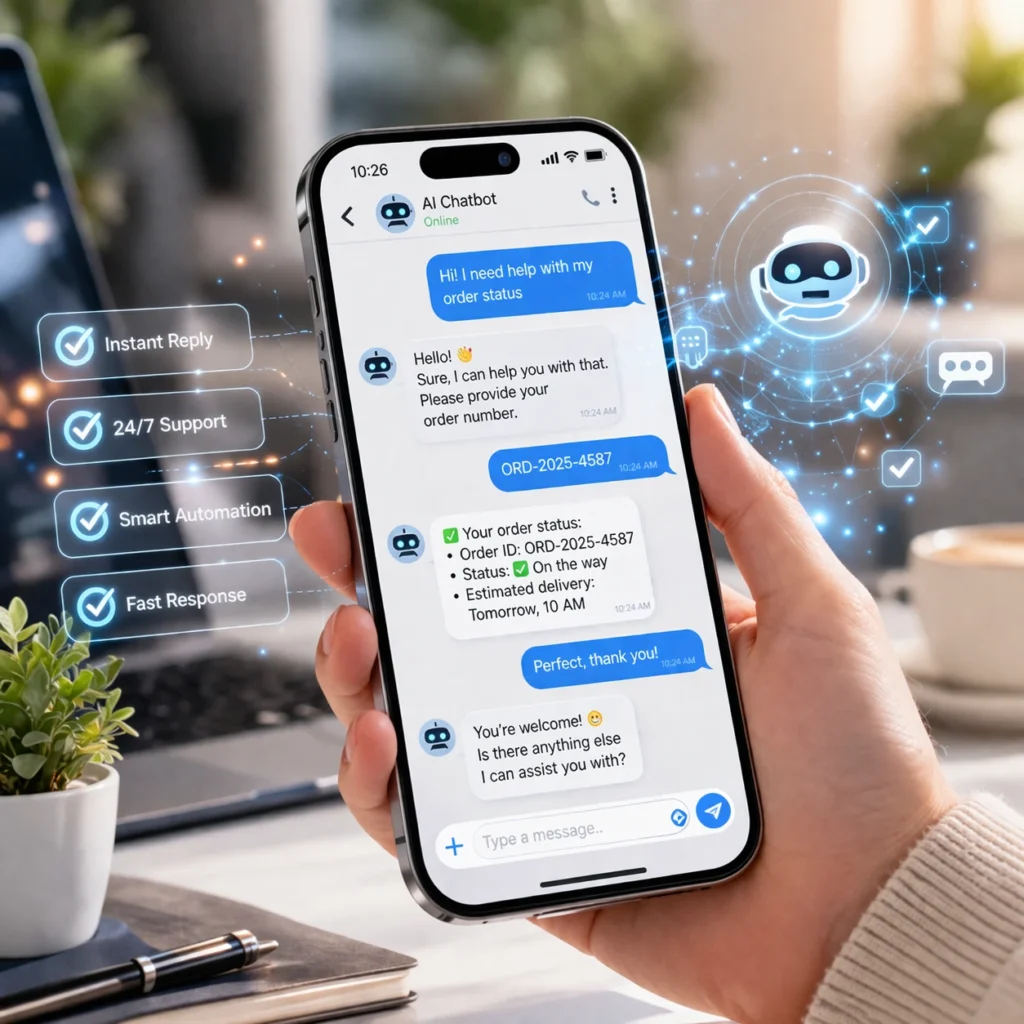
It interacts with your consumers via text or voice, understanding and responding to their inquiries through natural language processing (NLP). A chatbot can provide rapid responses to questions such as “What are your opening hours?” and “How do I track my package?”
However, it’s vital to realize that its understanding is limited by its training; it’s a brilliant communicator within its restricted domain, not a solution to complex, unknown problems.
2. How do AI chatbots differ from traditional chatbots?
One of the primary differences between an AI chatbot and a conventional chatbot is their intelligence and adaptability. Let us take a look at their breakdown:
| Feature | AI Chatbot | Regular Chatbot |
| Core Logic | Machine learning (ML) and natural language processing (NLP) | Pre-programmed scripts and rule-based reasoning |
| Language Undestanding | Understands nuances, intent, and differences in language | Limited to specified keywords and exact phrasing |
| Learning Ability | Dynamic; learns and improves from each interaction | Static; cannot learn through interactions |
| Response Style | Flexible, personalized, and contextually relevant | Fixed; predetermined responses |
| Complexity Handling | Better suited to handle complex and open-ended questions | Struggles with difficult or diverse questions |
| Adaptability | Adaptable and capable of evolving over time | Inflexible; requires manual reprogramming |

3. What are some of the most prevalent applications of AI chatbots in business?
AI chatbots are quickly transitioning from a novelty to a critical asset, poised to transform how Malaysian businesses work and interact with customers.
Here’s how Malaysian businesses use AI chatbots and the benefits they provide:
- Customer Support
The incorporation of always-on assistants is changing the way customer support works. Chatbots adeptly handle common inquiries about products, services, policies, and basic troubleshooting, allowing human agents to focus on more complex or sensitive issues.
Their 24/7 availability ensures immediate assistance at any time, considerably increasing client happiness and accessibility, particularly for those in different time zones.
Furthermore, improved AI enables these chatbots to assess previous interactions and customer data, allowing them to provide tailored responses and recommendations for a better user experience.
They are also capable of efficiently managing ticket triage by gathering preliminary information and routing clients to the most appropriate human agent or department, hence optimizing the overall support workflow.
- Lead Generation
In the world of lead generation, chatbots are essential tools for nurturing potential clients. They can actively engage website visitors by providing support and information, catching their attention, and identifying potential leads.
Chatbots capture important information about a visitor’s wants and intents through focused questioning, allowing prospects to be qualified before they reach the sales team.
Furthermore, they help to nurture these leads during the early stages of the sales funnel by delivering useful content such as brochures, case studies, and pricing information.
- Appointment Scheduling
Chatbots streamline appointment scheduling, significantly simplifying the booking procedure.
They provide automated booking for a variety of services, allowing consumers to easily book, reschedule, or cancel appointments without having to engage directly with a human.
Seamless interaction with existing calendar systems assures precise availability while successfully preventing double reservations.
Furthermore, chatbots improve productivity by sending automatic reminders for forthcoming appointments and managing follow-ups, reducing no-shows.
- Answering FAQs
Chatbots excel at addressing commonly requested questions because they act as a centralised knowledge store, providing quick and consistent solutions to typical requests.
This capacity considerably reduces the stress on human agents by handling repetitive inquiries, allowing them to focus on more complex issues.
As a result, clients benefit from faster response times and receive rapid answers to their issues, which increases satisfaction and leads to a better overall experience.
- Providing Product Information
Chatbots play an important role in providing product information and empowering customers with knowledge. They can provide extensive descriptions that include product characteristics, specifications, and benefits.
Furthermore, by assessing consumer inquiries and browsing history, chatbots can provide relevant product recommendations and suggest upgrades or complementary items, thereby improving the sales process.
They also act as essential resources by giving how-to manuals, troubleshooting steps, and links to other useful materials, ensuring that clients have the information they require at their fingertips.
4. How can an AI chatbot help my business?
AI chatbots provide numerous benefits to your organization, beginning with a considerable improvement in the customer experience via quick help and readily available replies. Chatbots dramatically improve operational efficiency by automating repetitive jobs like answering frequently requested queries and basic troubleshooting, freeing up human agents to handle more complicated issues.
This automation also directly translates into lower operational expenses, as fewer human resources are required for regular requests.
Furthermore, chatbots can actively engage website visitors and qualify prospects with targeted queries and information sharing, resulting in higher lead production. Finally, these intelligent assistants collect significant data insights on customer behavior, preferences, and pain points, which are critical for corporate strategy and progress.
5. What is the mechanism that drives rule-based chatbot responses?
These chatbots work by directly matching user input to a pre-existing set of rules and phrases. If a question or phrase matches a programmed trigger, the chatbot provides the predetermined answer.
A simple example is when a user inquires, “What are your opening hours?””; if programmed with this rule, the chatbot will respond in a standard manner.
6. How are AI chatbots normally hosted, and what are my options?
Providers frequently provide deployment flexibility, including options such as cloud hosting, local (on-premise) hosting, or a hybrid method.
When selecting a hosting provider, businesses should carefully analyze these alternatives and their implications to ensure that the solution matches their strategic, technical, and operational frameworks.
Addressing Your Concerns
7. What steps are required to start up a support chatbot on your own?
To set up a rule-based chatbot, you must first define a certain set of rules, effectively “if-then” logic, as well as pre-designed chatbot templates. These determine its responses based on a limited comprehension.
A machine learning chatbot, on the other hand, is created by training it with relevant data, such as common customer assistance questions and their related answers, allowing it to learn and generate its own responses.
Here are some examples you can begin with.
| Beginner-Friendly / No-Code | More Technical / Customizable |
| – Manychat (Focuses on social messaging) – Chatfuel (Focused on social messaging) – Tidio (All-in-One: Chat, Bot, and Email) – LandBot (Conversational Landing Pages/Bots) – Intercom (Comprehensive messaging platform) | – Dialogflow (Google Cloud) (powerful NLU) – Amazon Lex (AWS): Integration with AWS – Rasa (Open-source and Python-based) – Botpress (Open-source with visual and coding options) |
8. Should my firm incorporate an AI-powered chatbot into its operations?
Chatbots provide a simple entry point into automated customer care for organizations of all sizes, making them especially useful for those with a high volume of customer interactions or support requests.
They can improve reaction times and availability. However, effective execution necessitates a deliberate approach.
Businesses must recognise that chatbots have limitations and carefully assess how they integrate into their overall customer service framework to leverage their benefits while avoiding any negatives.
In Malaysia, chatbots are rapidly being considered “right” for organizations because current trends directly address significant pain areas for both customers and businesses.
Employing customized, multilingual, integrated, and ethically executed chatbots enables Malaysian businesses to improve customer happiness, increase productivity, broaden their reach, and foster trust in a digitally transformed market.
9. How customizable is the AI chatbot? Can it be adapted to our brand’s voice and aesthetic?
Absolutely! An AI chatbot may be easily customized to reflect your brand’s voice through changeable language, tone, and vocabulary.
Visually, platforms frequently let you customize the colors, logos, fonts, and chat window design to match your style. Beyond looks, the chatbot’s conversation flow and functions can be customized to meet your specific business requirements and client journeys.
To determine a platform’s exact customisation potential, it is recommended that you check its documentation or contact the vendor directly. A demo or trial can also provide useful information about the product’s customization capabilities.
10. Could you provide an estimate for the time required to deploy an AI-driven chatbot?
Setting up an AI-powered chatbot does not have a set schedule. It might take anywhere from a few weeks for simple implementations to more than a year for extremely complicated, enterprise-grade solutions.
Simpler, rule-based chatbots are the easiest to set up, but complex AI chatbots that require custom development and significant training take the longest.
11. Can we combine the AI chatbot with our social media channels to provide customer care there?
Indeed, expanding your customer assistance reach to social media via AI chatbot integration provides tremendous benefits in today’s interconnected digital ecosystem.
Many modern AI chatbot platforms are built with omnichannel capabilities in mind, allowing for easy integration with popular social media channels such as Facebook Messenger, Instagram Direct, and even Twitter (now X) direct messages.
This connection enables clients to receive fast support within the familiar context of their preferred social networking platform, thereby increasing convenience and customer satisfaction.
Furthermore, it guarantees a uniform support experience regardless of the channel used, as the AI chatbot uses the same knowledge base and brand voice across all touchpoints.
12. What proportion of the talk volume can the AI Chatbot handle?
AI-powered chatbots can handle a wide range of communication volumes, depending on their sophistication and implementation.
While well-designed chatbots can automate a considerable number of routine questions, frequently estimated between 60% and 80% or even higher, their usefulness increases with intelligence, especially when NLP and machine learning are included.
In comparison to human agents, one significant advantage is their capacity to manage multiple simultaneous conversations. However, the complexity of the queries and the need for integration with other systems have an impact on their handling capabilities.
Finally, while chatbots excel at basic activities, a smooth transition to human agents is critical for complicated or sensitive issues, and ongoing training is required to optimize their performance and assure customer satisfaction.
13. How open are customers to employing an AI-powered chatbot for support?
Given the widespread dissatisfaction with long wait times and poor customer service in call centers, wouldn’t an AI-powered chatbot, built to give quick, 24/7 help and seamless self-service across all channels, be a welcome answer for your customers?
In reality, evidence indicates a considerable customer willingness to adopt this technology to alleviate these typical pain points:
- Nearly 80% of consumers say they’d use a chatbot to avoid long lines, and the vast majority already do.
- Furthermore, studies show that a significant portion of consumers actively prefer using chatbots for quick resolutions, with 62% preferring them to waiting for human agents (Forbes), 74% relying on them for simple inquiries (PSFK), and 65% feeling confident resolving issues without human intervention (Adweek).
14. Data privacy and security are top priorities for us. How does Revenue Discovery protect the security of our data and our clients’ information when they use your AI chatbots?
Data privacy and security are critical concerns, and Revenue Discovery takes them very seriously when adopting AI chatbot systems.
To protect your data and your customers’ information, we follow the principles mentioned in our privacy policy. We are committed to protecting your personal information and follow the Personal Data Protection Act 2010 (PDPA) and MCMC recommendations.
We protect your data from unauthorized access by implementing industry-standard security methods such as SSL encryption, firewalls, and secure data centers.
The PDPA 2010 gives you the right to view, update, and delete personal data, as well as withdraw your consent to data processing. We are delighted to share additional information about our security measures and how we comply with the PDPA.
Beyond our dedication to securing our AI solutions, Revenue Discovery provides specialized cybersecurity services to safeguard your whole digital infrastructure.
Our skilled team, which includes CREST and OSCP-certified pen testers, can assist you in identifying vulnerabilities and implementing effective security protocols.
We offer complete penetration testing services for web applications, systems, networks, and cloud environments, intending to proactively identify vulnerabilities before they are exploited by bad actors.
As part of our cybersecurity evaluations, we conduct vulnerability assessments to determine your company’s compliance with industry best practices and standards, allowing you to improve your systems against emerging cyber attacks.
However, not all bot platforms follow the same criteria (just like other software). If you have special requirements, contact your IT staff and ask difficult questions before selecting a bot vendor.
15. How much return on investment (ROI) can we expect from implementing an AI chatbot? What are the key performance indicators (KPIs) to monitor?
An AI chatbot can have a considerable return on investment due to lower support costs, increased sales, higher customer happiness, and increased agent efficiency.
AI Chatbots may track several key KPIs, including:
- Resolution Rate
- Response time
- Customer satisfaction scores (CSAT).
- Lead Generation
- Task completion rates
We may go deeper into your specific requirements and goals to deliver a more precise and bespoke ROI prediction for your company.
16. How do AI chatbots help to improve customer experience?
Customers benefit from bots since they are available 24 hours a day, seven days a week, to answer their questions immediately.
You might think of them as helpers who are always available and can communicate with multiple individuals at once, resulting in shorter wait times. In addition, if the bot is unable to resolve the issue, it directs the consumer to a real person and informs them of what has already been communicated.
This means clients don’t have to repeat themselves, which is a huge benefit!

17. What type of budget should we expect when implementing a chatbot platform for customer support?
The cost of deploying a chatbot platform for customer assistance in Malaysia can vary greatly depending on numerous aspects, including complexity, customization requirements, platform and features, distribution channels, development and integration costs, and the need for maintenance and support. A general notion of the expected cost ranges you might expect is:
- Monthly fees range from free to RM 500. Platforms for basic chatbot functionality can range from RM 0 (free plans with limitations) to RM 500 per month. These are frequently appropriate for managing FAQs and simple inquiries over a limited number of channels. Examples include free tiers on sites such as Tidio and Chateefy.
- RM 800 to RM 2,000 or more per month: For more features, greater integrations, and higher contact limits, budget between mid-range chatbots such as Mampu AI (with tiered plans) and Chateefy’s subscription tiers.
- Anywhere between RM 5,000 and RM 50,000 per month: Fully customized AI chatbots with powerful NLP/ML, extensive integrations, and specialized support can range in price from the initial setup to potentially higher monthly subscription rates (if applicable).
For enterprise-level solutions, several platforms, such as Ada.cx (which is frequently priced in USD), can be in this pricing range. Hiring a local chatbot development provider for a completely customized solution may also fall into this category. It is critical to properly assess your needs and investigate available platforms before establishing a reasonable budget for adopting a chatbot platform for customer service in Malaysia.
18. AI Chatbots are beyond my price range. Are there any other options I may consider to support chatbots?
It is acceptable to look at alternatives if AI chatbots are now out of your price range. Fortunately, there are a few more effective strategies to improve your customer support:
- Creating a thorough FAQ and introducing contextual self-service are both cost-effective strategies to empower customers to help themselves.
- For real-time interaction, look at free or low-cost basic live chat with human beings.
- Simpler rule-based chatbots can provide initial automation for a lesser cost than full AI solutions.
- Video courses and a knowledge base offer visual and detailed self-service choices.
- Prioritise solutions that address common customer issues based on your current resources, with the option of researching AI chatbots as your business grows.
Remember to prioritise solutions that solve your clients’ most common pain areas and are compatible with your available resources.
You can always revisit the idea of integrating more powerful AI chatbot solutions as your company expands and your budget allows.
19. What are some of the potential obstacles to consider while using bots?
While the initial setup necessitates rigorous structure, the main challenges are frequently caused by insufficient preparation.
For example, launching a bot without first assessing client interactions across several channels (chat transcripts, emails, and phone calls) may result in a solution that does not successfully fulfill user demands.
Similarly, failing to assign unambiguous ownership, do extensive pre-launch testing, or define a maintenance policy might result in serious problems.
Finally, matching the bot’s capabilities with both company objectives and consumer needs via a well-defined deployment strategy is critical to avoiding future issues.
20. Does chatbot customer service outperform basic websites, X (previously Twitter), and phone assistance in terms of customer experience?
Chatbot customer service frequently outperforms traditional websites, Twitter, and phone help, particularly in terms of immediate accessibility.
Chatbots are preferred over phone assistance by 64% of clients due to their 24/7 availability, which meets the demand for immediate help.
Chatbots, which are integrated into a variety of platforms, accomplish duties such as order fulfillment and lead creation efficiently, optimizing the customer journey. They also improve call center efficiency by handling common inquiries, allowing human agents to focus on more difficult topics.
While chatbots excel at availability and efficiency, human agents are still necessary for empathy and complex issue resolution. Finally, a combination of chatbot automation and human interaction frequently produces the best customer experience.
Thus, while not universally superior, chatbots provide significant benefits in modern customer service.

Stop wondering and start benefiting. Discover your AI solution.
The concept of an AI chatbot may seem daunting, but keep in mind that intelligent chatbots are your digital buddies, created to enhance your company’s skills.
You don’t have to be a tech whiz to use their power.
Consider intelligent chatbots to be your always-on, ever-helpful digital pals, ready to assist your business grow without the need for a technical degree.
Use AI Chatbots to unlock your Malaysian company’s potential. Contact our specialists for a consultation and see how Revenue Discovery’s software and AI development services may help your organization grow and innovate.